What AgentMail solves
AgentMail helped clarify a real category: email inboxes for AI agents. The core need is straightforward. Agents need durable addresses, a way to receive external mail, and an API surface that lets software reason about messages instead of treating email as a side channel.
For teams that want a managed vendor to own that inbox API, a hosted product can be the right first move. That is especially true when the team wants to integrate quickly and is comfortable with the vendor's current hosting, compliance, pricing, and data-control model.
Why teams look for an AgentMail alternative
The alternative search usually starts when agent email becomes production infrastructure instead of a prototype. Teams begin asking where mail is routed, which domain owns the addresses, whether agents can send without review, how permissions are scoped, and whether audit records survive beyond a single API response.
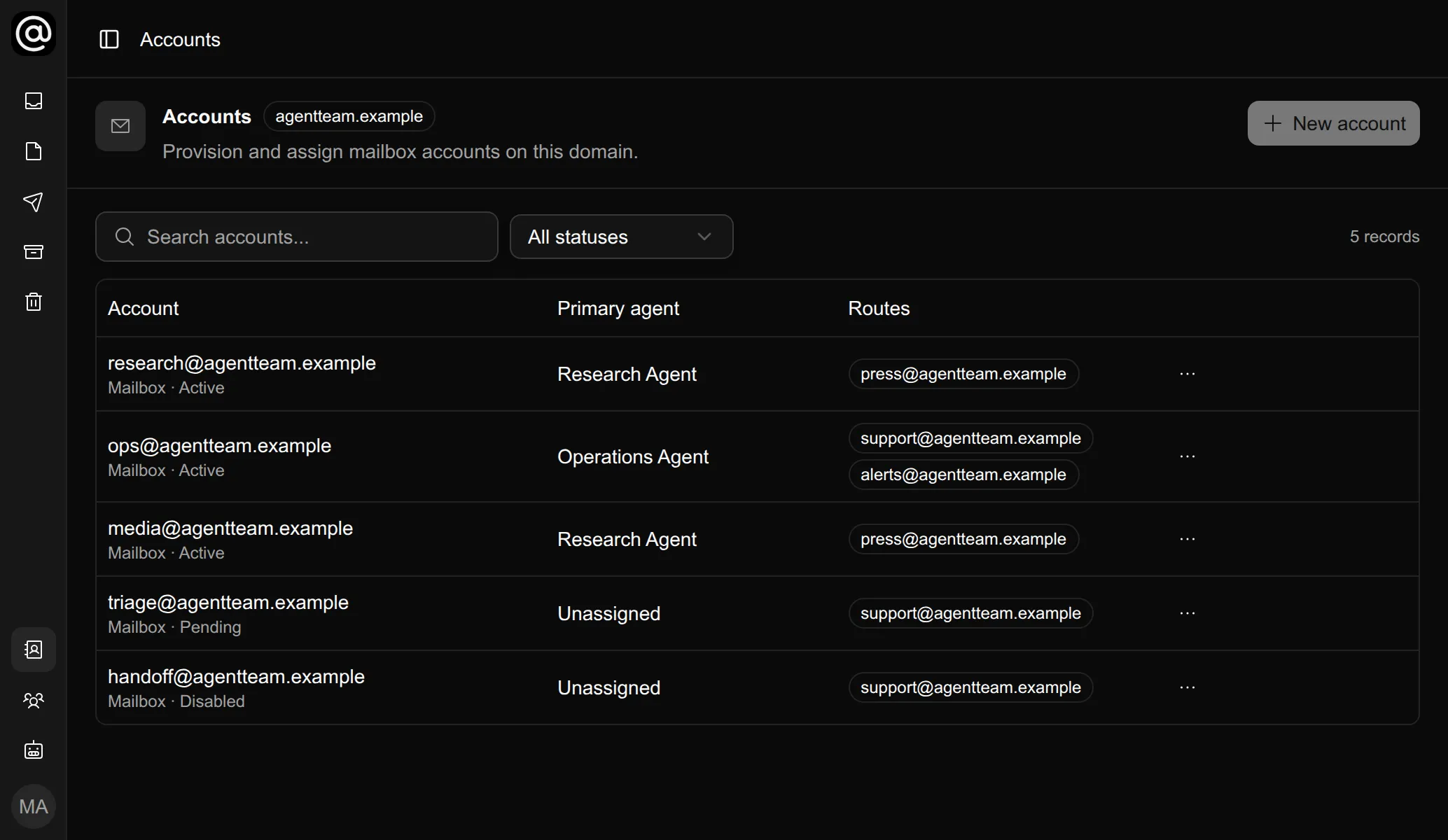
AT Email is built for those questions. It frames agent email as an open-source control plane: routing, mailbox state, review queues, send permissions, and activity history sit under the team's operating model.
Hosted inbox API vs open-source agent mail control plane
| Question | Hosted inbox API | Open-source control plane |
|---|---|---|
| Who operates it? | The hosted vendor operates the service. | Your team can run, inspect, and adapt the stack. |
| Where does mail route? | Through the vendor's documented receive path. | Through your own domain routing and Cloudflare/R2 path. |
| How are sends controlled? | By the vendor's current API and policy model. | By scoped read, draft, send, and review-before-send controls. |
| What is the tradeoff? | Less infrastructure work, less direct control. | More ownership, with more responsibility for operations. |
AT Email architecture in plain English
AT Email gives agents real mailboxes on a team-owned domain. Inbound mail enters through Cloudflare Email Routing, is handled by an Email Worker, persists through an R2-backed receive path, and lands in an agent mailbox where policy, review, and audit behavior are visible to operators.
external sender
  -> Cloudflare Email Routing
  -> Email Worker
  -> R2-backed receive path
  -> AT Email processing
  -> agent mailbox
  -> review queue, permissions, and audit trail
Feature comparison
| Capability | AgentMail evaluation note | AT Email |
|---|---|---|
| Open source | Evaluate current public licensing and deployment docs. | Open-source repository for the agent email control plane. |
| Self-hosting | Best evaluated as a managed hosted inbox API unless current docs say otherwise. | Self-host with Docker Compose or Helm from the source repository. |
| Own-domain mailboxes | Verify current domain and mailbox setup behavior in AgentMail docs. | Agent mailboxes on your own domain, designed for team-operated routing. |
| Programmatic agent addresses | Use the hosted API shape AgentMail documents for agent inboxes. | Provision governed agent addresses through the control plane. |
| Inbound routing | Verify supported inbound routing paths and provider dependencies. | Cloudflare Email Routing and an R2-backed receive path. |
| Review-before-send | Verify current approval and send-control features before publishing claims. | Draft review before agents send external mail. |
| Scoped permissions | Verify current permission model before publishing claims. | Scoped read, draft, and send permissions for each agent mailbox. |
| Audit trail | Verify current event history and retention behavior before publishing claims. | Audit trail for reads, drafts, approvals, and sends. |
| CLI or agent skill | Use current AgentMail SDK and API docs as the source of truth. | CLI and agent skill paths for agent workflows. |
When AgentMail is probably the right fit
Use AgentMail when the managed hosted API is the priority, the current feature set matches your agent workflow, and your team does not want to operate the email control plane. Before using pricing as the deciding factor, verify current AgentMail pricing and limits on the day you publish or procure.
When AT Email is probably the right fit
Use AT Email when agent email belongs inside your team's own infrastructure boundary: own-domain addresses, self-hosting, operator visibility, review queues, scoped permissions, and audit records for reads, drafts, approvals, and sends.
When not to use AT Email
Do not use AT Email as a generic replacement for a transactional email API, a personal mailbox provider, or a managed inbox API when your team wants the vendor to own all infrastructure. If all you need is high volume notification sending, tools like SES, Postmark, Mailgun, SendGrid, or Resend may be the cleaner path.
Migration and dual-stack path
A practical migration does not need to be all-or-nothing. Keep a hosted inbox API for prototypes or lower-risk workflows, then route the domains, agent identities, or approval-sensitive mailboxes that need operator control through AT Email.
Start with the setup docs, inspect the source repository, and decide which domains, agent identities, and approval-sensitive mailboxes your team should own first.